
PlayinMatch exchange desk
PlayinMatch Exchange — Top Fancy Session Markets to Back or Lay From ₹100
Back a side at the price you want, or lay it and stand in for the bookmaker yourself: the PlayinMatch exchange pairs your ticket with another punter who holds the opposite view. Tickets start at ₹100 on fancy and session lines, and a lay carries a liability worth working out before you confirm.

PlayinMatch Exchange Seat — Clear Sign-In Before the Next Session Line
Sign in with the ID you already hold; the same wallet funds exchange tickets from ₹100 and covers any lay liability.
No ID Yet? Ask for One Before the ₹100 Session OpensHow Does the PlayinMatch Exchange Work? A Clear Back and Lay Ticket
On the PlayinMatch exchange you never bet against a house price; you bet against another punter who has taken the opposite view. One side backs, saying a result will happen, the other lays, saying it won't, and the exchange pairs the two tickets at a price both accepted, with ₹100 as the smallest ticket on either side.
That is the whole idea. Everything else grows out of it.
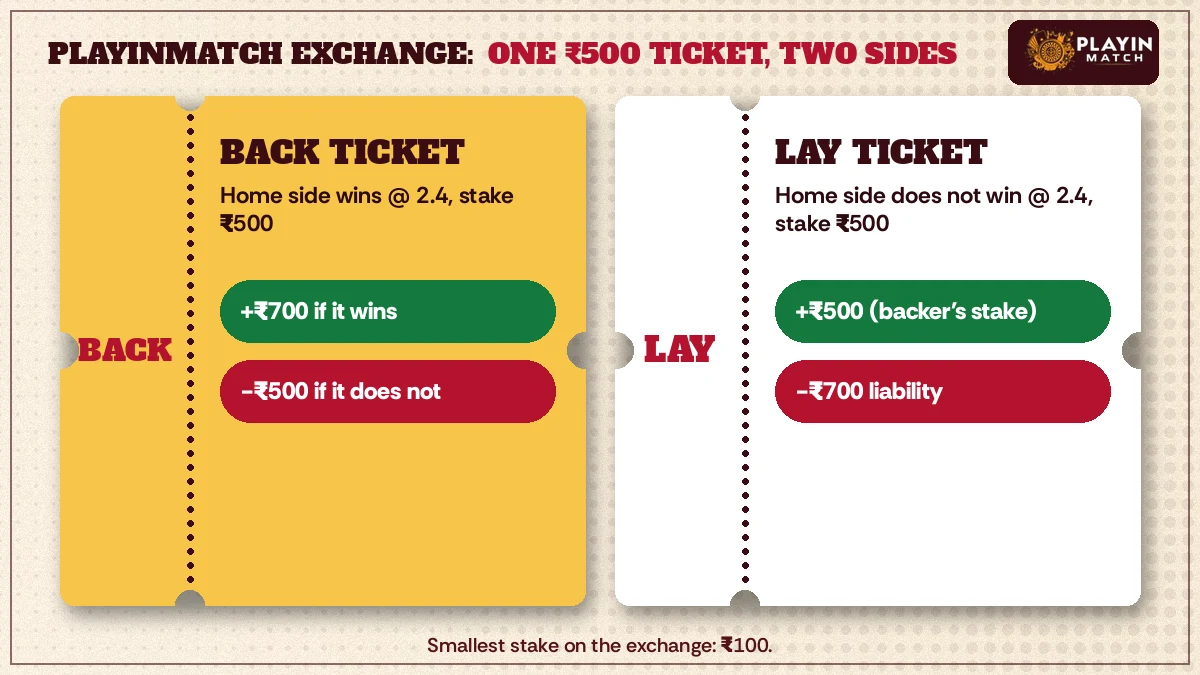
Back ticket (example)
You say: the home side wins
Price taken: 2.4
Stake: ₹500
If they win: +₹700 profit
If they lose: −₹500
Lay ticket (example)
You say: the home side does not win
Price given: 2.4
Backer's stake accepted: ₹500
If they lose: +₹500
If they win: −₹700, your liability
Put the two tickets next to each other and the mirror is obvious. The backer's ₹700 upside is the layer's ₹700 exposure; the layer's ₹500 upside is simply the backer's stake changing hands. Nobody in the middle sets that number. If the backer had asked for 2.6 and no layer would give it, the ticket would wait, unmatched, and that waiting state decides what can still be pulled back (the cancel section further down deals with it).
So where do the prices come from? From people queuing on each side of PlayinMatch's odds ladder. The best back price and the best lay price sit next to each other, often a tick or two apart, and the gap closes as more money arrives. On a busy T20 chase it can be very tight. On a slow Test afternoon it may be wide, and a price you type in could sit for a good while before anyone takes it.
Which column you press decides the speed. Taking the best price already on offer, backing at the best back or laying at the best lay, matches straight away because someone is already waiting there. Asking for anything better puts your ticket into the queue instead. Neither is wrong. One trades a slightly worse price for certainty; the other gambles a little time for a slightly better number, and on a PlayinMatch fancy line that is about to suspend, time is the thing you have least of.
Tests add one wrinkle that T20s mostly don't: the draw. Laying a side in a Test covers two outcomes at once (the other team winning, or the match being drawn), whereas backing the other team covers only one of them. In a T20 there's no draw to speak of, so laying one side and backing the other end up close to the same position. Close, not identical, since the prices on the two sides rarely line up exactly.
Wickets move the ladder more than anything else, which is why a lot of PlayinMatch users keep the PlayinMatch live score today page open in a second tab while they read prices.
PlayinMatch Exchange Liability Maths — a Proven Way to Price a ₹500 Lay
The figure typed into a lay's stake box belongs to the backer. Your own risk is a second number, bigger whenever the price is above 2.0, and mixing the two up is the slip new PlayinMatch exchange users tend to make first.
Here is the standard example, worked line by line.
- Backer's stake you accept
- ₹500
- Price you lay at
- 2.4
- Liability formula
- stake × (price − 1), so ₹500 × 1.4
- Liability
- ₹700: this leaves your balance if the selection wins
- If the selection loses
- you keep the backer's ₹500
A ₹500 lay can cost ₹700.
The higher the price you lay at, the more lopsided it gets, and a lay at a long price turns even the ₹100 minimum into real exposure: laying ₹100 at 6.0 carries ₹500 of liability, while laying ₹100 at 1.5 carries only ₹50. Same ticket size, ten times the risk.
Expect the PlayinMatch wallet to need the liability free, not just the stake. A lay that reads ₹500 in the box needs ₹700 of room behind it, and if two lays on different matches are open together, both liabilities are held at the same time: ₹700 plus whatever the second one carries.
Backing is gentler. Your stake is the most you can lose, and the profit is stake × (price − 1), so ₹500 backed at 2.4 returns ₹1,200 in total, ₹700 of it profit. Same numbers as the lay, sitting on the other side of the table.
A punter in Pune laid ₹500 on the favourite at 2.4 halfway through a chase, sure he was risking five hundred. The favourite got home with an over to spare and ₹700 left his PlayinMatch balance, not ₹500. He had read the stake box as the risk box, which is probbly the most common exchange mistake there is.
One habit fixes it. Before confirming any lay, multily the stake by the price minus one and ask whether you'd be fine losing that figure. If the answer is no, lower the stake or skip the ticket.
Settlement runs the other way round. When a back wins, the stake comes back along with the profit, so the ₹500 at 2.4 shows up as ₹1,200. When a lay wins, the held ₹700 is released and the backer's ₹500 is added on top. When either loses, the money that was held simply doesn't come back. Nothing on PlayinMatch settles halfway through, either: a match-odds ticket waits for the result, and a session ticket waits for the last ball of its overs.
Popular PlayinMatch Exchange Markets: Fancy Lines and Session Runs
A ₹100 ticket on a PlayinMatch session line can be won or lost inside six overs. That speed is the draw: the question is small, and its answer turns up while the match is still in its first hour.
A session market asks about a block of an innings. Will the batting side reach a certain total by the end of the sixth over, or the tenth, or the twentieth? You see two figures, a lower No and a higher Yes, often a run or two apart. Taking Yes means you expect the side to reach the higher figure. Taking No means you think they'll finish under the lower one.
An example line makes it clearer. Suppose the six-over line reads No 52 and Yes 54 (made-up figures, purely to show the shape). A Yes ticket needs the side on 54 or more when the sixth over ends. A No ticket needs 51 or fewer. A total of 52 or 53 falls into the gap between the two figures, which is the stretch neither ticket covers, and that gap is the first thing experienced PlayinMatch session punters look at before anything else on the line.
Fancy markets are narrower still. A batter's own score, whether a wicket falls in a particular over, how many a partnership adds before it breaks. They open and shut quickly. They also tend to be suspended the moment something big happens (a wicket, a review, a rain break), which is annoyingly the exact moment most people want to get in.
The ₹100 floor applies here as well, and that makes session lines a sensible way to learn how the PlayinMatch board reacts: the question settles inside a few overs, the ticket is small, and you see a full cycle from placement to settlement in one sitting rather than waiting for a whole match.
The title of this page names both formats for a reason. In a T20 the whole six-over block can hinge on one bowler's bad over, so a line set at the start may look silly twelve balls later. Test lines barely twitch for long spells, then lurch the moment a wicket falls. Neither format is harder, exactly; one asks for quick reactions on the PlayinMatch ladder, the other for patience.
One practical difference between fancy and match-odds tickets: a fancy or session ticket is usually settled and done within the same innings, so the ₹100 comes back into the balance (or doesn't) while the match is still going. A back on the match result ties that money up until the last ball, which in a Test can mean days.
Other sports on the board, and what each of them carries, sit on the PlayinMatch online live sports page; this PlayinMatch exchange page stays with cricket's back, lay and session lines.
Popular PlayinMatch Exchange Searches
- playinmatch exchange
- playinmatch how to cancel bet
- playinmatch back and lay
- playinmatch fancy market
- playinmatch session bet
- playinmatch lay liability
- playinmatch exchange minimum stake
- playinmatch bet cancel kaise kare
- playinmatch unmatched bet
- playinmatch andar bahar
Reliable PlayinMatch Exchange Terms in One Fold
Top PlayinMatch Exchange Words and What They Mean
People search for playinmatch exchange when they want one of two things: the board where back and lay tickets get paired from ₹100 upward, or a plain reason why a lay shows a bigger number than its stake. Both are covered on this page, and the table below is the short dictionary for the words that turn up on every PlayinMatch ticket.
| Term | What it means on the exchange |
|---|---|
| Back | You say a result will happen; the most you lose is your stake |
| Lay | You say it will not happen; you risk the backer's potential winnings |
| Liability | Stake × (price − 1) on a lay, so ₹500 at 2.4 carries ₹700 |
| Unmatched | Waiting for a punter on the other side; still cancellable |
| Matched | Paired with another punter; fixed until the market settles |
| Session | Two figures, No and Yes, on the batting total when a named over ends |
| Fancy | A narrow question, such as one batter's runs or a wicket in an over |
PlayinMatch How to Cancel Bet — the Clear Short Version
Searches for playinmatch how to cancel bet nearly always come from someone looking at a ticket they already regret. The rule is short. An unmatched ticket, or the unmatched part of one, can be cancelled; a matched ticket cannot. Once it has matched, the way out on the PlayinMatch exchange is an opposite ticket, a lay against your back or a back against your lay, sized so the result lands roughly level whichever way the market settles.
PlayinMatch Exchange Stake Floor — Clear Minimums From ₹10 Spins to ₹100 Tickets
The smallest ticket on the PlayinMatch exchange is ₹100, back or lay, on fancy and session lines alike. Elsewhere on PlayinMatch, casino tables and Andar Bahar share that ₹100 floor and slots are the one exception, spinning from ₹10.
Those are floors, not suggestions. Nothing stops a bigger ticket, but a first week spent at ₹100 on session lines teaches the PlayinMatch ladder at the lowest price the exchange allows.
| Where on PlayinMatch | Smallest stake | What the floor applies to |
|---|---|---|
| Exchange back or lay | ₹100 | The ticket stake; a lay's liability can be larger |
| Fancy and session markets | ₹100 | Same exchange floor, per ticket |
| Casino tables | ₹100 | Per bet at the table |
| Andar Bahar | ₹100 | Per round |
| Slots | ₹10 | Per spin |
Two things follow from that table. First, ₹100 is the working unit almost everywhere on PlayinMatch, so a ₹1,000 balance is roughly ten exchange tickets, or ten Andar Bahar rounds, before anything comes back. Second, slots break the pattern. An odd ₹40 left over after a settled session can't place an exchange ticket at all, but it does cover four spins.
The floor on a lay sits on the stake, not the liability. Lay ₹100 at 3.0 and the ticket is at the minimum while your exposure is ₹200. In other words the ₹100 figure tells you the smallest ticket, not the smallest risk. The ₹500 lay from earlier, shrunk down, makes the same point.
What about typing ₹90? Expect the exchange to refuse it rather than round it up for you; retype the amount at ₹100 or above. A hedge ticket is a fresh ticket too, so it also has to clear ₹100, which matters when you are trying to trim a small position. Trimming a ₹150 back, for example, might need a lay larger than feels natural.
Andar Bahar and the other card games have their own rules, laid out on the PlayinMatch game page. Sign-in for all of it runs through PlayinMatch login, and one ID covers the exchange and the tables, so there's no second account to fund.
PlayinMatch How to Cancel Bet — Clear Rules for Unmatched and Matched Tickets
Only a PlayinMatch exchange ticket still waiting for a taker can be cancelled. The moment another punter accepts it the ticket is locked, because their money now rests on it too, and from then on the one lever left is a second ticket on the opposite side that offsets the first.
Why would a ticket sit unmatched in the first place? Usually because you asked for a better price than anyone is offering. Back at 2.6 when the best available is 2.4 and your ticket waits in the queue at 2.6 until a layer agrees, or until the market drifts away and nobody ever takes it.
Cancelling a waiting ticket is the easy case. Find it among your open bets, where waiting tickets are kept apart from matched ones, and cancel it. The money held for it comes back to usable balance: the stake on a back, the liability on a lay. That second part surprises people, because a cancelled ₹500 lay at 2.4 frees ₹700, not ₹500.
Partial matches are the awkward one. Say you backed ₹1,000 at 2.4 and only ₹600 found a layer before the price moved. That ₹600 is matched and fixed. The other ₹400 is still waiting, and that part (only that part) can be cancelled. It's also why a ticket can show as partly cancelled on the PlayinMatch bet list, which looks like an error the first time but isn't.
Want a different price rather than no ticket at all? The simplest route is to cancel the waiting one and place a fresh ticket at the new number. The replacement goes to the back of the queue at its price, so if you were close to being matched at the old figure, moving it can cost you that place. Small moves are usually better done by waiting a minute first; large ones, by cancelling straight away before the market shifts further.
A few things tend to confuse people here:
- No cancel option at all usually means the ticket has already matched; check the matched list.
- Only part of the money came back? The rest matched first, before you cancelled.
- A market that suspends at a wicket or at the end of a session changes the picture, and what happens to a waiting ticket then is hard to say in general, so read its status on your own list rather than assuming.
Matched tickets are where hedging comes in. The maths below uses example prices only, to show the shape of it when the market moves your way.
- Original ticket
- Back ₹500 at 2.4, matched
- Price later in the match
- 1.8, the side is now favoured
- Hedge ticket
- Lay ₹667 at 1.8, liability ₹533.60
- If the side wins
- +₹700 − ₹533.60, about ₹166
- If the side loses
- −₹500 + ₹667, about ₹167
Roughly level either way. The hedge stake comes from dividing the original back stake times its price by the new price: ₹500 × 2.4 ÷ 1.8, which is about ₹667. When the price moves against you instead, the the same method caps a loss rather than locking in a profit; what it can never do is make the first ticket disappear.
So the order of thought on PlayinMatch is short. Unmatched: cancel. Partly matched: cancel the rest, then decide about the matched bit. Fully matched: hedge, or let it run.
Popular PlayinMatch Exchange Questions With Clear Answers
How does the PlayinMatch exchange actually work?
It pairs punters who disagree. One backs a result, another lays it, and the PlayinMatch exchange matches the two tickets at a price both accepted, from a ₹100 minimum. No bookmaker sets that price; it comes from whoever is queuing on each side, so it moves as money and wickets arrive.
Can I cancel a bet on PlayinMatch after placing it?
Only if it has not matched yet. An unmatched PlayinMatch ticket, or the unmatched part of a partly taken one, can be cancelled from your open bets. A matched ticket is fixed with another punter, so the only way to change that position is an opposite ticket that hedges it.
What do back and lay mean on PlayinMatch?
A back ticket is a vote for something to happen and a lay ticket is a vote against it. On PlayinMatch the backer can lose no more than the stake, but the layer covers the backer's profit, so a ₹500 lay at 2.4 risks ₹700 to win ₹500.
What is the smallest stake on the PlayinMatch exchange?
It is ₹100 per ticket, whether you back or lay, and that covers fancy and session markets too. Casino tables and Andar Bahar also start at ₹100, while slots spin from ₹10. On a lay the ₹100 is the stake, so the liability can be larger at higher prices.