
PlayinMatch safety check, done by you
Is PlayinMatch Safe — Clear KYC and Payout Facts to Judge It Yourself
Test it rather than trust a stranger's word. Log in from a new phone and an OTP should reach your registered number; withdraw a small amount and it should land only in a bank account under your own name; after ₹50,000 of total payouts, PlayinMatch asks for KYC documents. Those checks decide it.
A Clear PlayinMatch Login Test: Watch the OTP Arrive Yourself
Check number one starts here. Sign in on a handset PlayinMatch has never seen, and count the seconds until the code shows up on your registered SIM.
No ID Yet? Request One and Test the CaptchaIs PlayinMatch Safe? Six Proven Checks Stamped One by One
Most people who type "is playinmatch safe" into Google want a yes or a no. Fair enough. But a yes from a website is only words, and the same goes for a no from an angry comment thread. What you can actually verify is how PlayinMatch behaves around your money and your login, and there are six points where that behaviour is visible. Each one takes minutes, not days. Run them in any order, though the order below is roughly how a new account meets them.
- 01OTP on every new device
- Log in from a phone or laptop the account has not used before and PlayinMatch sends a one-time code to your registered number. No code, no entry. If someone else has your password, they still stall at this screen. Pass condition: the code arrives on your SIM, and nobody from any desk ever asks you to read it back to them.
- 02KYC once payouts cross ₹50,000
- Documents are not demanded on day one. PlayinMatch asks for KYC when your cumulative withdrawals go past ₹50,000, which means the check is tied to money actually leaving, not to signing up. Pass condition: the request comes at that point, through the account, and not as a random chat message before you have withdrawn anything.
- 03Payouts only to a same-name bank account
- Withdrawals go to a bank account held in the name on your PlayinMatch profile. A cousin's account will be refused, and so will a friend's. That rule feels strict the first time. It is also the thing that stops a stolen login from being cashed out somewhere else.
- 04Captcha on the login form
- The PlayinMatch sign-in form carries a captcha. It is a small step, and it exists to slow down scripts that hammer a login page with guessed passwords. Pass condition: you see it on the real form.
- 05A small test withdrawal
- Before you deposit anything serious, withdraw the smallest amount the cashier accepts and time it. The floor and the usual timings sit on the PlayinMatch withdrawal time page, so compare what you see against that rather than against a promise in a chat.
- 06The address you are typing
- Stamps one to five mean little if the password goes into a lookalike page. Read the address bar, letter by letter, and match it to an entry on the PlayinMatch com mobile addresses page. Pass condition: an exact match before a single character of the password is typed.
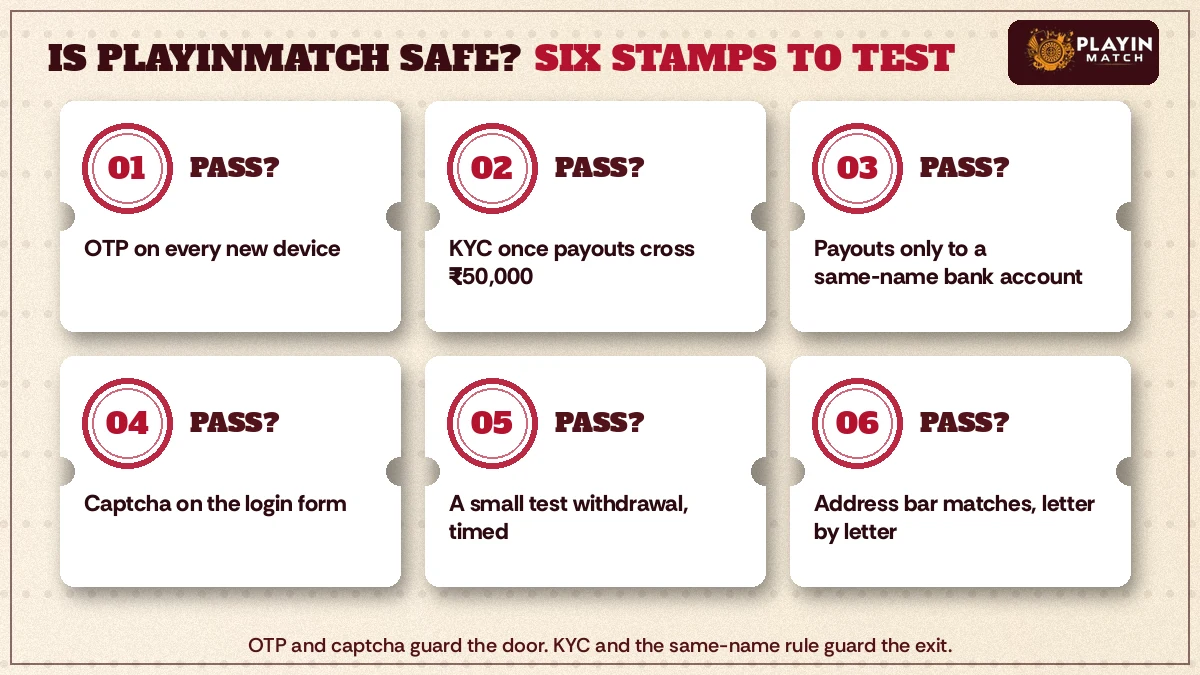
Checks two and three are the ones that protect a baance after a win. OTP and captcha guard the door; KYC and the same-name rule guard the exit. If you only have ten minutes, do the OTP test and a small withdrawal and leave the rest for later.
Reliable Fixes When a PlayinMatch Safety Check Fails
A failed stamp does not always mean trouble. Sometimes it means a setting on your side. Here is how each failure usually reads, and what to do before you draw a conclusion about PlayinMatch.
The OTP never arrives. Nine in ten of these trace back to an old number: the account was opened on a SIM that has since been swapped or ported, so the code is landing somewhere you are not. Ask for a fresh code once, a minute or two later. If the registered number is no longer yours, stop and contact the desk through the PlayinMatch care channels to update it. Do not accept a code that someone "forwards" to you on chat. The whole point is that it reaches you directly.
The withdrawal is refused. Almost always a name mismatch. The holder name on the bank account has to match the name on your PlayinMatch profile, and a missing initial or a spouse's account is enough to stop it. Annoying, yes. Also exactly what you want to happen if someone else were at the cashier.
A KYC request turns up early. Do the arithmetic. Add up what you have withdrawn so far; if it is nowhere near ₹50,000 and the demand came through a private message, it did not come from PlayinMatch. Check with the desk before a single scan leaves your phone, and read the PlayinMatch privacy policy notes to see which details this website holds and which it never receives.
No captcha on the login form. Close the tab. The genuine PlayinMatch form has one, so a login page without it is most likely a copy, and the fix is to go back to the published mirror list.
PlayinMatch Real or Fake: Clear Signs Your ID Came From the Right Desk
"PlayinMatch real or fake" is really two questions stuck together. One is whether the brand itself runs a working betting desk. The other, and in practice the one that costs people money, is whether the ID in your hand was issued by that desk or by someone borrowing the name. The brand can be real while a particular ID is fake. That distinction matters more than anything else on this page.
Reliable PlayinMatch Real-or-Fake Signals Inside the Account
A genuine PlayinMatch ID behaves the same way the six stamps above describe. Log in from a second phone and it demands an OTP to the number you registered. The login form shows a captcha. The cashier will only send money to a bank account whose holder name matches your profile. And when your total payouts approach ₹50,000, the KYC request shows up inside the account.
Every one of those behaviours is a nuisance for a fraudster. That is exactly why they are useful to you. An ID that skips them, say one that lets you withdraw to any account you like or never asks for an OTP on a fresh device, is not behaving like PlayinMatch. Treat that as a red flag even if the site looks right.
Top Warning Signs a PlayinMatch ID Is Fake, Not Real
- Someone on chat asks you to forward the OTP that just reached your phone. The code exists so that only you hold it. Anyone asking for it, whatever name they use, is working against you.
- The seller of the ID says they can route your winnings to their account and pass them on. The genuine PlayinMatch cashier has no such side door; stamp three exists to close it.
- You are told KYC documents are needed before you have withdrawn anything at all, and the request arrives as a DM rather than through your account.
- The address in your browser is not on the mirror list, or it was sent to you by a stranger with a promise of a bonus.
One composite case, pieced together from the sort of messages the desk hears. A player in Pune got an ID through a contact on Instagram, deposited, won a little, then tried to withdraw. The "agent" asked for the OTP to "confirm the transfer". He sent it. The balance was gone within the hour, and the login had never been on the real site at all.
Short version: the brand name on the screen proves nothing. The checks do. If you are unsure where your ID came from, message the desk through the channels listed on the PlayinMatch customer care page and ask them to confirm it (they can see whether the username exists; a copycat cannot fake that from the outside).
PlayinMatch Review: Proven Points Players Raise, No Invented Stars
You will not find a star rating here. We could make one up, the way plenty of review sites do, but a number with no count behind it tells you nothing about whether PlayinMatch pays. What a fair PlayinMatch review can do is list what players tend to bring up, the good and the irritating, and let you weigh it.
The complaints that come up most are about friction, not about money vanishing: the OTP step on a new phone, the refusal to pay into a relative's account, and the KYC request after the ₹50,000 mark. Each of those is a safety feature seen from the impatient side.
On the plus side, players mention that the same PlayinMatch ID works across the mirror addresses, so a blocked domain does not mean a lost balance. They also mention that support sits on WhatsApp and Telegram rather than behind an email form; the PlayinMatch support desk details cover both. Some people know the brand as PlayinMatch99, and a few assume that is a separate operator. It is the same name in another form, explained on the PlayinMatch99 page.
Where reviews go wrong is when they judge the brand by an ID that never came from it. A surprising share of "PlayinMatch is fake" posts, when you read them closely, describe paying an unknown agent and never seeing the real login screen. That is a real loss. It is just not a verdict on PlayinMatch.
So read reviews for patterns, not for heat. Several people describing the same slow step is useful. One furious post with no detail is noise, probably.
Is PlayinMatch Legal in India? The Clear State-Level Picture
Your PlayinMatch login is the same in Kochi and in Kolkata. The law around it is not. Betting sits mostly with state legislatures, several of them have outlawed online betting, and and the rest lean on statutes drafted for card rooms and racecourses, which leaves the phone-app question open to argument.
None of this is legal advice; we are a betting brand, not a law firm. You will also notice this page shows no licence badge for PlayinMatch. That is deliberate, and a badge you cannot verify on another site should make you more careful, not less.
Think of it as a seventh line on the receipt, one PlayinMatch cannot stamp for you. The other six test the account. This one tests your postcode, and if it fails, the other six stop mattering.
What we can say factually is narrower. Being 18 or older is required. Your PlayinMatch account is tied to your phone number through the OTP and to your bank through the same-name payout rule, so it is not anonymous. Plan on the basis that your activity is traceable to you, because it is.
PlayinMatch Banned in India? Reliable Facts About Blocked Addresses
People search "playinmatch banned in india" usually after an address stops loading. That is a domain block, and it happens to betting sites regularly. Internet providers are told to block a domain, the domain stops loading on home broadband and mobile data, and it looks from the outside as if PlayinMatch has been shut down.
It has not, in the sense most people fear. A block on an address is an instruction to internet providers, not a case against the people who used it, and it does not freeze a PlayinMatch balance. The same ID and the same wallet open on a mirror address. The current mirrors are kept on the PlayinMatch mobile address list, which is the only place you should take a new address from.
That said, a block is also the moment copcats move in. When the usual domain fails, you are more likely to click a link from a stranger, and that link may lead to a login page that is not PlayinMatch at all. So the blocked-address situation loops straight back to stamp six. Check the address. Then log in, and expect the OTP if the device is new.
Popular PlayinMatch Banned-in-India Mix-Ups, Sorted
- "The site is down, so PlayinMatch is banned." Usually one address is blocked; the brand runs on another.
- "My balance is gone because of the ban." A domain block does not touch the wallet; log in on a listed mirror with the same ID.
- "Players will be arrested." An ISP block targets the address. Your state's law is the thing to check, as covered above.
PlayinMatch Safe or Not — The Proven Verdict After Six Stamps
Our verdict: PlayinMatch is safe to use in the ways you can check, provided the ID is genuine and your state allows it. Those two conditions carry most of the weight.
The account protections are real and they are the annoying kind, which is a good sign. OTP on each new device, a captcha at sign-in, KYC once withdrawals total ₹50,000, and payouts locked to a bank account in your name. A copycat operation has every reason to skip all four, because each one gets in the way of taking money. PlayinMatch keeps them.
Where PlayinMatch cannot protect you is outside the account. If you hand over an OTP, pay an unknown agent, or type your password into an address you got from a stranger, none of the six stamps help.
So, is PlayinMatch safe? For a player who gets the ID from the right desk, checks the address, keeps the OTP private and runs a small test withdrawal first: yes, as far as any betting account can be. For anyone skipping those steps, the risk is mostly theirs to create. Start from the PlayinMatch login page rather than a forwarded link, and you have already cleared the most common trap.
A Proven Ten-Minute Run of the PlayinMatch Safety Test
Here is how the test goes in practice for someone new. You get the ID from the desk, not from a forwarded contact. You open the address from the mirror list and see the captcha on the login form: two stamps, maybe a minute. You then sign in from a second device, a family tablet say, and wait for the OTP on your own SIM. Third stamp.
Next comes the small withdrawal to your own bank account, the one whose holder name matches your PlayinMatch profile. You note the time you asked and the time it lands, and compare both against the published PlayinMatch payout timings. That is stamps four and five. The KYC stamp comes later, only if your payouts ever add up to ₹50,000; you cannot force it early, and you should not try.
Ten minutes, give or take the bank. That is less time, honestly, than most people spend scrolling through reviews.
Get a Desk-Issued PlayinMatch ID, Then Test a Small Withdrawal
Popular PlayinMatch Safety Questions on Legal, Fake and Genuine IDs
Is PlayinMatch safe to use from India?
It is safe to the extent you can check: a genuine PlayinMatch ID asks for an OTP on every new device, shows a captcha at login, pays out only to a bank account in your own name and asks for KYC after ₹50,000 of withdrawals. The larger risks sit outside the account, with fake agents and copied addresses.
Is PlayinMatch real, or is it a fake site?
PlayinMatch is a working brand, but a real brand does not make every ID real. Judge your own ID by its behaviour. If it never asks for an OTP on a new phone, or lets you withdraw to someone else's account, it did not come from the PlayinMatch desk and you should stop using it.
Is it legal to play on PlayinMatch in India?
It varies. India leaves most gambling law to individual states, and a number of them prohibit real-money betting online. Read the current rules for the state where you live before creating a PlayinMatch ID. The booth cannot offer legal advice, so treat everything on this page as general information.
Has PlayinMatch been banned in India?
What people usually run into is a blocked address, not a closed brand. Internet providers can be told to block a domain, and the same PlayinMatch ID and balance then open on a listed mirror. Take new addresses only from the official mirror list, never from a stranger's message.
Is PlayinMatch legit, and does it actually pay out winnings?
Payouts go only to a bank account under the name on your PlayinMatch profile, which blocks a stolen login from being cashed elsewhere. The sensible move is a small test withdrawal before any large deposit, timed against the published withdrawal timings. KYC documents are requested once total withdrawals pass ₹50,000.
What do players say in PlayinMatch reviews?
Most complaints are about friction: the OTP on a new phone, refused payouts to a relative's account and the KYC request after ₹50,000. Many posts calling PlayinMatch fake describe paying an unknown agent and never reaching the real login. We publish no star rating, because an invented number would not help you.
How can I tell if my PlayinMatch ID is genuine?
Log in from a device the account has not used and confirm an OTP reaches your registered number, then check the captcha on the login form. If you are still unsure, ask the PlayinMatch care desk on WhatsApp or Telegram to confirm your username exists. Never share the OTP with anyone who asks for it.
Top PlayinMatch Review and Safety Searches From India
- is playinmatch safe
- playinmatch review
- playinmatch real or fake
- playinmatch legal in india
- playinmatch banned in india
- playinmatch safe hai ya nahi
- playinmatch asli hai ya fake
- playinmatch withdrawal proof
- playinmatch99 legit
PlayinMatch Safety Ledger — Best Terms Players Search Before Joining
Is PlayinMatch Safe and Real? Clear Notes on the Top Searches
Anyone asking is PlayinMatch safe, or searching PlayinMatch real or fake, is asking the same underlying thing: will the account hold up when money moves. The answer on this page rests on six repeatable checks rather than on a rating, and the ones that matter most are the OTP sent to a new device and the same-name bank payout. A PlayinMatch review worth reading describes those steps, not just a feeling.
- is playinmatch safe: judged by OTP, captcha, KYC past ₹50,000 and same-name payouts
- playinmatch real or fake: the brand is one question, your ID's source is another
- playinmatch review: patterns across many players beat one loud post
PlayinMatch Legal in India and Banned in India: Reliable Terms Explained
Searches for PlayinMatch legal in India and PlayinMatch banned in India often get mixed up. The first depends on your state's betting law; the second usually means an internet provider has blocked one address, while the ID works on a listed mirror.
- legal in india
- Decided by your state rather than nationally. Where your state prohibits online wagering, skip the account; this card is general information only.
- banned in india
- Mostly domain blocks by ISPs, which do not close a PlayinMatch wallet.